
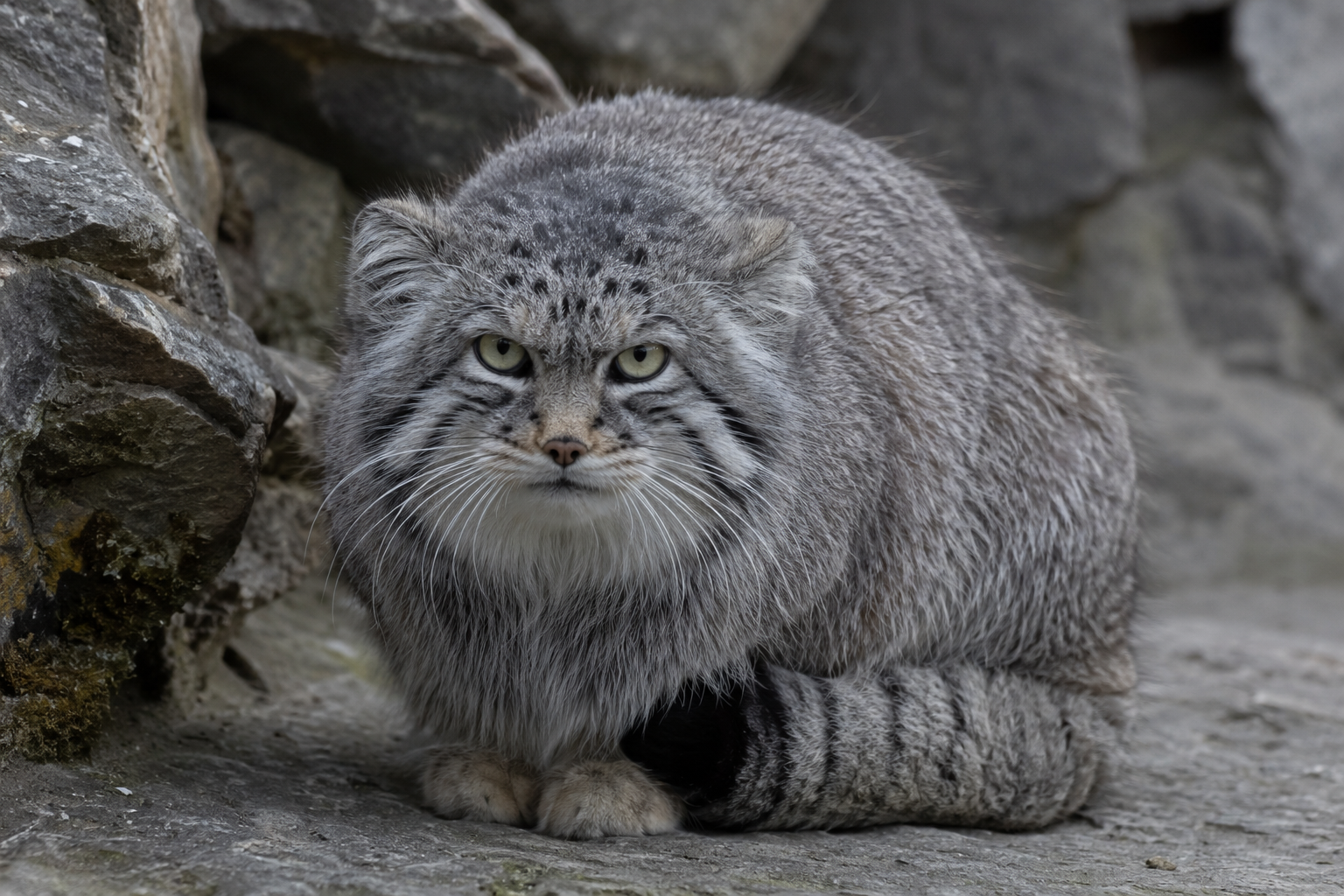
Pallas’s Cat
Have you ever come across a cat that looks perpetually grumpy, impossibly fluffy, and wildly captivating all at once? Meet Pallas’s Cat, one of the most extraordinary wild felines on the planet. Also known as Manul Pallas’s (or simply the Manul), this remarkable creature has fascinated wildlife enthusiasts for centuries with its record-breaking dense fur and uniquely expressive flat face.
If you’re looking for a complete Pallas’s Cat information guide, you’ve come to the right place. Unlike the cats that curl up on your couch, the Pallas’s cat is a wild species native to the cold grasslands of Central Asia and it’s every bit as extraordinary as it looks. In this guide, we’ll cover everything you need to know about the Pallas’s Cat, from its appearance and history to why this remarkable species belongs in the wild, not in your living room.
Pallas’s Cats Physical Appearance
The Pallas’s Cat breed always seems to have a “grumpy” look, with a stocky build, and the densest fur of any feline. Their fluffy appearance makes them look larger than domestic cats, but they’re actually smaller compared to typical domestic cats. They have long and dense light gray fur, and round ears set low on the sides of the head. Their long bushy tail is well camouflaged and adapted to the cold continental climate in its native range. Lastly, Pallas’s Cats have a flat face and circular pupils, which make them visually unique.
Pallas’s Cats Personality and Temperament
The table below shows how the Pallas’s Cat's personality and temperament typically ranks across different traits. This will help you understand why this cat isn’t meant to be domesticated.
Legend:
- ⭐ = Poor
- ⭐⭐⭐⭐⭐ = high/excellent
Trait | Rating |
Friendliness | ⭐⭐ |
Ability to adapt | ⭐⭐⭐ |
Behavior towards other pets | ⭐ |
Behavior towards humans | ⭐⭐ |
Playfulness | ⭐⭐⭐ |
Tendency to obesity | ⭐⭐ |
Overall health | ⭐⭐⭐ |
Life expectancy | ⭐⭐⭐ |
Easy to train | ⭐ |
Advisable for first-time owners | ⭐ |
Key Characteristics of Pallas’s Cats
Have a look at this Pallas’s Cat information sheet to know what makes them unique. Keep in mind that these values can still vary from one cat to another.
Average lifespan | Usually live 8-12 years in the wild, and slightly longer in captivity |
Weight | The Pallas’s Cat’s weight for both male and female are 4.4-11 lbs (2-5 kg); they are similar in size. |
Height | Head-and-body length ranges between 18-26 inches, with a bushy tail which is 8-12 inches long. |
Coat | Thickest fur of any cat species, long and dense, changing color seasonally |
Size | The Pallas’s Cat’s size is similar to that of domestic cats, but appears larger due to their stocky build and fluffy coat |
Personality | They prefer to be solitary, are secretive, and territorial. |
Origin | Pallas’s cat is a natural breed native to Central Asia’s steppes and rocky grasslands, from Iran and Mongolia to Tibet and Siberia |
Table of Contents
Pallas’s Cat History
Manul Pallas’s, also known as the Pallas’s Cat, was first described in 1776 by German naturalist Peter Simon Pallas. He observed them in the vicinity of Lake Baikal in Russia. Pallas’s Cats are ancient wildcats, perfectly adapted to the cold steppes and rocky grasslands of Central Asia. Many people ask, where do Pallas cats live now. Apart from its natural habitat, this breed has been living in zoos since the early 1950s. Since 2018, 60 zoos in Europe, Russia, North America, and Japan have participated in Pallas's Cat breeding and conservation programs.
Types of Pallas’s Cats
Many people wonder, ‘What is a Manul cat or Pallas’s Cat and how do they differ from domestic breeds?’ The answer is, there’s no such thing as domestic Pallas’s Cats. It’s a wild cat, so there aren’t many types identified either. However, researchers found some variation in coat color and size:
- Grayish coat: Found in colder regions such as Mongolia and Siberia.
- Reddish coat: Found in warmer, rocky grasslands like Iran and Afghanistan.
How Long Do Pallas’s Cats Live?
The average life span of a Pallas’s Cat is 8-12 years; they can sometimes live even longer. In captivity, their life can be longer due to human care and reduced risk of predators. The Pallas’s Cat’s habitat includes cold, dry steppe grasslands and rocky regions of Central Asia. However, habitat loss has put them in danger.
Now, coming to the Pallas’s Cat's conservation status, they are not considered endangered but are likely to become so soon. Both Pallas’s kittens and adults face threats from predators like wolves, eagles, and stray dogs, making survival in the wild quite challenging. The cat breed is listed on the IUCN’s Red List of Threatened Species. While populations seem to be declining in the western parts of their range, these secretive cats are notoriously hard to count.
How to Care for a Pallas’s Cat?
The honest answer: you can’t, and you should never try. A domestic Pallas’s Cat simply does not exist, and keeping one in a home is harmful to the animal and illegal under wildlife conservation laws in most countries.
Though you may be wondering: is a Pallas’s Cat dangerous? While not inherently aggressive, a stressed or confined one will defend itself and show agresssion. Even a Pallas’s Kitten should never be removed from the wild. In accredited zoos and conservation centers, these cats require large enclosures mimicking their natural rocky steppe Pallas's Cat habitat, a carefully managed diet, and minimal human contact to prevent chronic stress.
Pallas’s Cat Grooming and Maintenance
Unlike domestic cat breeds, typical grooming and maintenance does not apply to a Pallas’s Cat. Grooming is nature’s job here, not a human one. Their extraordinarily dense fur is self-regulating, and it’s built for insulation against extreme cold and seasonal shedding. In zoo settings, caregivers monitor coat health as part of routine welfare, but there is no brushing, bathing, or professional grooming involved.
Are Pallas’s Cats Suitable for Indoor Living in the Philippines?
Pallas’s Cats are not suitable for indoor living in the Philippines, as they prefer freezing temperatures. The Philippines' hot and humid climate would make them suffer from heat and stress. They are strictly wild animals that cannot adapt to indoor living, especially in a tropical climate such as the Philippines.
Pallas’s Cat Nutrition and Diet
- Primary Pallas's Cat Diet: Small mammals (pikas, voles, marmots), birds, insects.
- Adapted Metabolism: Suited for survival in harsh climates with limited prey.
- Captivity Diet: Must be similar to wild prey, as commercial cat food is unsuitable.
Appreciating The Pallas's Cat
Pallas cats may look irresistibly fluffy and expressive, but they are wild cats with unique instincts, specialized needs, and a natural lifestyle that is very different from domesticated cats. Learning about their appearance, behavior, habitat, and diet helps cat lovers better appreciate what makes this rare feline so fascinating.
While Pallas cats are not suitable as pets, understanding wild cat breeds can help pet parents become more curious and thoughtful about the nature of felines. For more tips on cat breeds, behavior, nutrition, and everyday care, explore the WHISKAS® blog and discover more ways to understand and support the cats we love.